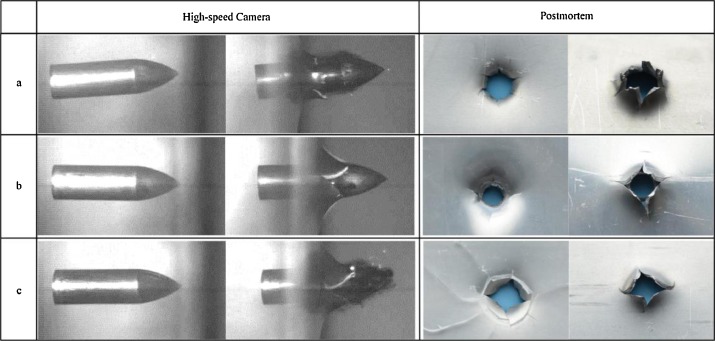
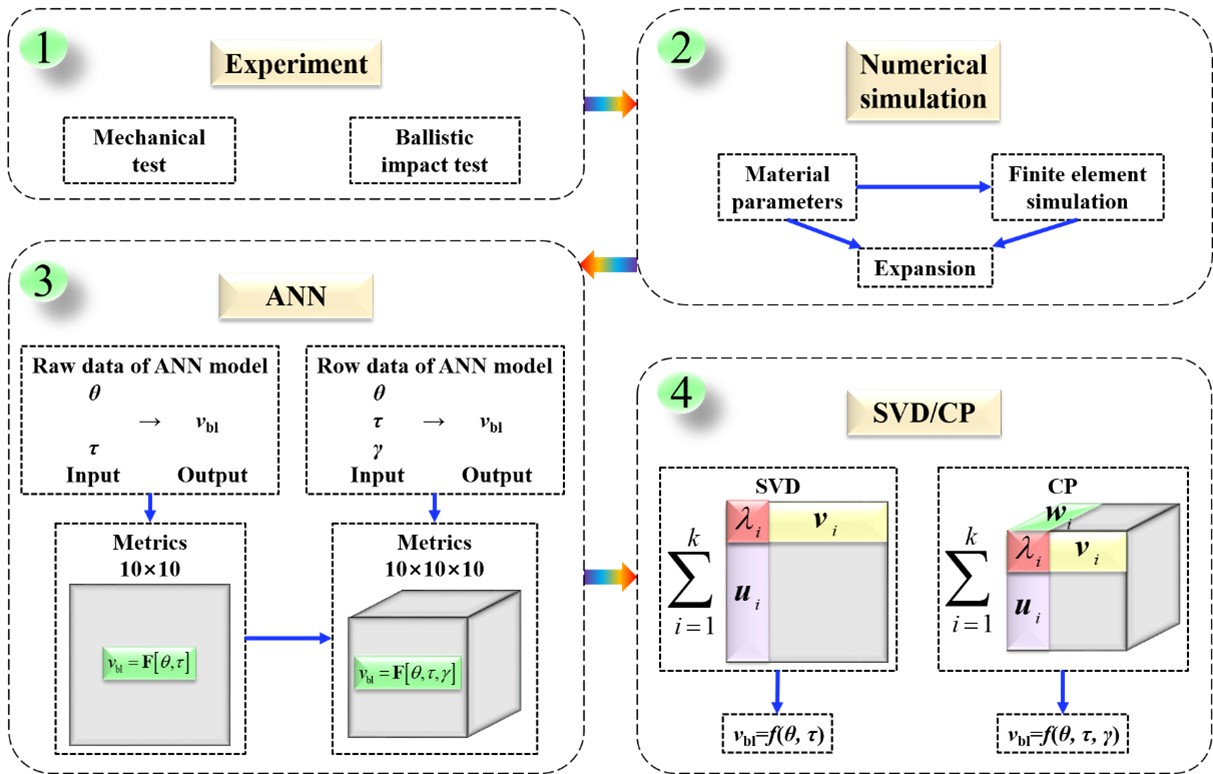
Ballistic penetration problems involve complex, multi-parameter interactions between projectile geometry, impact velocity, target thickness, and obliquity. Classical analytical models (e.g., Recht-Ipson) capture single-variable trends but fail to generalise across parameter combinations. This research develops data-driven surrogate models for ballistic penetration — using ANN combined with SVD/CP tensor decomposition (the same methodology established in constitutive modeling) to predict ballistic limit velocity (BLV) and residual velocity across the full multi-parameter impact space. The surrogate models are trained on experimental datasets augmented by validated FEM simulations, enabling accurate, physics-grounded predictions for protective structure design.
Key Contributions
- General ANN-based ballistic limit velocity (BLV) model accounting simultaneously for target thickness, impact angle, and projectile nose shape
- Combines experimental data with validated FEM simulations to generate training datasets for sparse ballistic data scenarios
- k-Fold cross-validation implemented for reliable model assessment with small sample sizes
- SVD/CP decomposition applied to reveal decoupled relationships between BLV and independent parameters
- Rank-1 decomposition achieves <6% MAPE while capturing fully decoupled effects of all input variables
- Equivalent analytical models derived for direct engineering application
Key Contributions
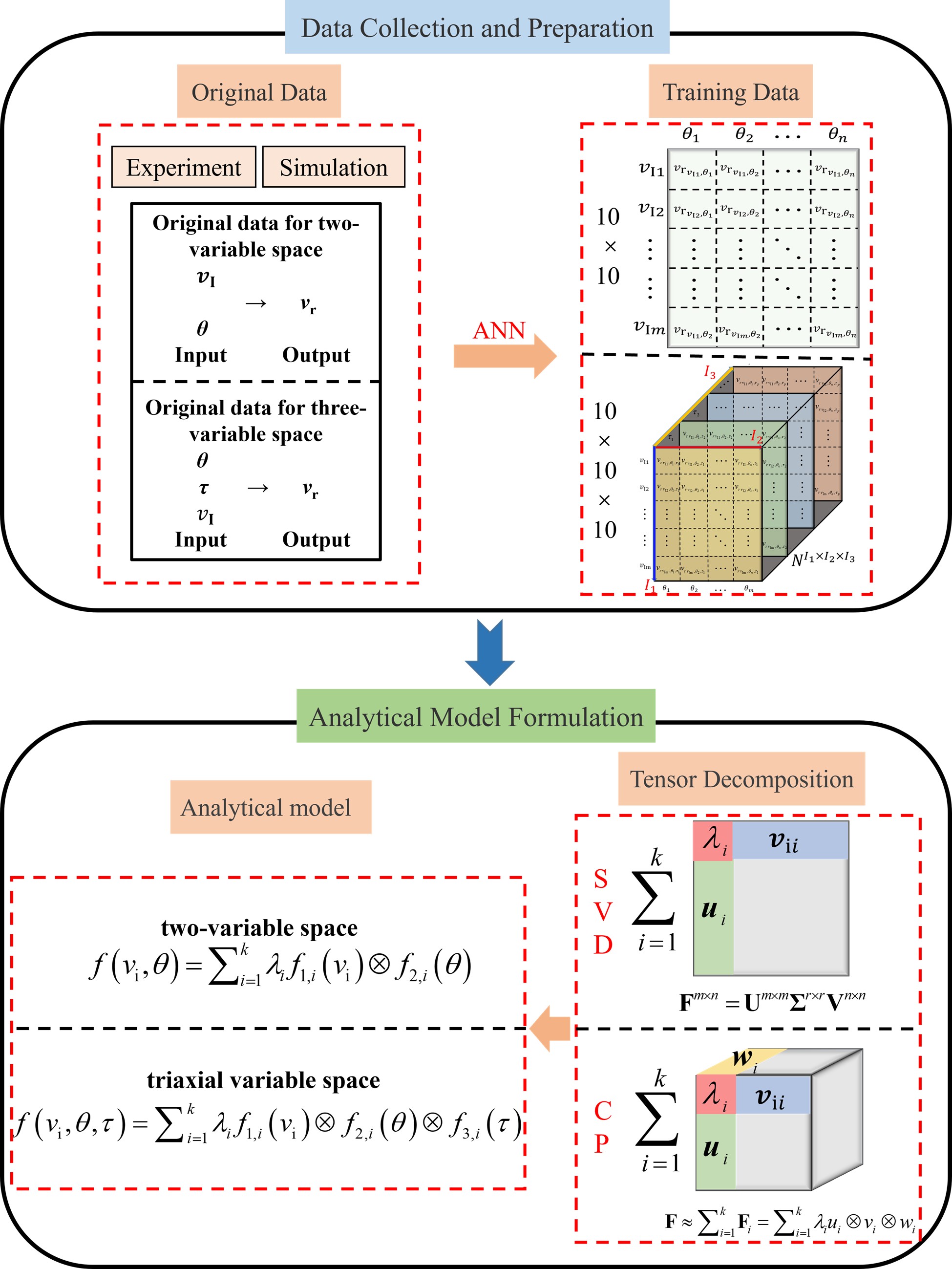
- Comprehensive ANN-based residual velocity surrogate model covering multiple impact variables: initial velocity, target thickness, impact angle, projectile nose shape
- Extended dataset generated by combining experimental results with validated numerical simulations
- ANN + SVD/CP decomposition framework extended from BLV surrogate to residual velocity prediction
- "Safe region" and "perforating region" identified and mapped in multi-parameter impact space
- Decoupled CP components physically correlated with material failure mechanisms
- Outperforms classical Recht-Ipson model for multi-parameter residual velocity prediction
Key Contributions
- Systematic experimental study of polymer-aluminium bi-layer protective plates against projectile impact
- Comparison of polycarbonate (PC) vs. polymethyl methacrylate (PMMA) polymer layers with AA2024-T4 aluminium
- Effect of projectile nose shape (blunt vs. ogival) on penetration and deformation mechanisms
- Effect of polymer layer placement (impact side vs. back side) on ballistic performance
- PC layers provide superior ballistic resistance improvement over PMMA; nose geometry significantly affects failure mode
- Establishes the experimental dataset and design guidelines that underpin later surrogate model development